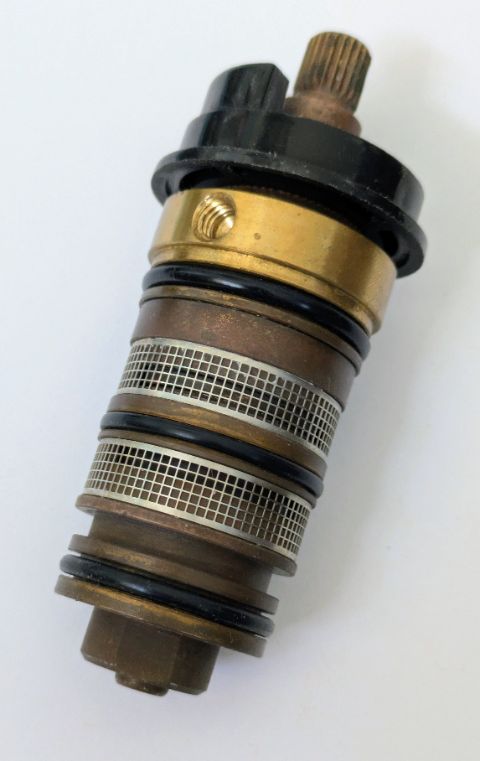
 As part of a bathroom renovation, I upgraded to a shower column with a thermostatic valve. Rather than statically mixing the hot and cold water, the thermostatic valve contains a cartridge with a wax element that dynamically adjusts the ratio of hot to cold water, maintaining a constant output temperature even if another water fixture is opened. Thermostatic cartridges also implement safety features: if the cold water pressure suddenly drops, the cartridge cuts off the hot supply to avoid scalding,
Late last year, I was not able to increase the water temperature near the end of a shower - turning the control to full hot only delivered barely lukewarm water. The manufacturer recommended removing the thermostatic cartridge and soaking it in a decalcifying solution. That helped, but the problem returned a few months later. They also recommended "exercising" the cartridge by rotating through the fully hot and fully cold positions to clear any lime, but that made the problem worse. The final option was disassembling the shower column and cleaning the supply side filters.
I eliminated the last possibility by turning off the cold water supply - the shower delivering hot water in the fully hot position, but the valve cut off the water when in the normal position. Unfortunately, I was not able to find detailed information on how thermostatic cartridges work, nor could I find a recommended hot water supply temperature. In hindsight, that led me to develop an incorrect model of how the cartridge might work, a challenge Don Norman covers at length in The Design of Everyday Things. I decided the cartridge had failed and ordered a replacement. It worked noticeably better - no unexpected cool showers and the temperature was more stable for the entire shower.
Unfortunately, the problem reoccurred last week. I had turned off the gas to the water tank while on vacation, which meant having to reset the temperature control. In the past, his sometimes results in a slightly lower hot water temperature even if the setting is the same, at least for a month or so. My latest working theory is that the thermostatic cartridge requires a minimum hot water temperature. This would explain why the the problem occurred late in my shower and when I was second in line for a shower.
I tracked down the manufacturer of the thermostatic cartridge and was surprised to receive a quick response. They claimed that the hot water supply needs to be at least 45°C (113°F). Based on safety recommendations, I set the thermostat on the water tank to deliver at most 49°C (120°F) hot water at fixtures. Repeated hot water usage combined with an inconsistent gas hot water tank thermostat could easily drop the faucet temperature below 45°C. Up to that point, the thermostatic cartridge compensated, making me think everything was fine.
The good news is that increasing the temperature to 50°C (122°F) seems to provide a good balance between reliable showers without dramatically increasing the risk of scalding. Also, I was able to retrieve the old thermostatic cartridge from my recycling bin, so I now have a spare.
Blog comments