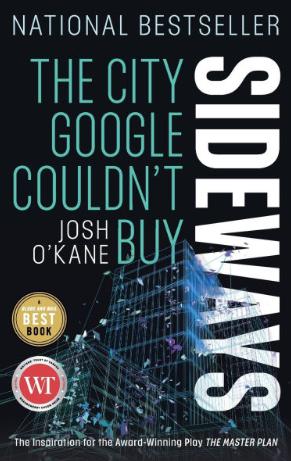
 I was intrigued by the Soulpepper/Crow's Theatre production of The Master Plan and purchased Josh O'Kane's Sideways: The City Google Couldn't Buy on which the play was based. O'Kane is a Globe and Mail reporter who investigated the story as it unfolded and shared his insights in 335 pages of text backed up by almost 60 pages of notes and a comprehensive index.
My initial reaction was the Quayside project was too small to be financially viable and required that Alphabet (Sidewalk Lab's parent company) take a loss in the hopes of getting future benefits such as leveraging what it learned from Toronto in future projects. This led to endless discussions between Waterfront Toronto and Sidewalk Labs around data privacy and Waterfront Toronto's share in any intellectual property that the project delivered.
Waterfront Toronto and Sidewalk Labs were very different organisations in terms of how they worked, exacerbated by Waterfront Toronto having three masters (federal, provincial, and civic) that were not always fully engaged in the process. Not enough effort was spent trying to understand how the other side thought and functioned. Using the Request For Proposal (RPF) process suggested a lack of understanding by both parties about the challenges of actually implementing complex innovation. That said, a co-creation approach might also have been difficult given the concerns subsequently raised about the procurement process. Ironically, it appears that Waterfront Toronto and Sidewalk Labs finally developed a better working relationship early in 2020 only to have covid-19 crush urban real estate valuations. Alphabet was no longer willing to lose money on the project, so the deal collapsed.
In addition to promoting sustainable construction and equitable housing, Waterfront Toronto wanted Quayside to be hub for innovation. I like Weber's distinction between an idea, an invention (typically a prototype to assess feasibility), and an innovation (delivers value through practical applications). The road to innovation is long, hard, and costly - NASA's Technology Readiness Levels map the path and challenges. Sidewalk Labs RFP response included many ideas, a few of which might be considered inventions but not yet innovations. Digital innovations may seem less bound by the constraints of the physical world, opening up frontiers where anything is possible. However, although progress may be faster and less costly, digital innovations still need to mature and generate revenue through widespread adoption and an appropriate funding model. As with innovations in the physical realm, the full implications to society often only become clear much later. Ideas may be the starting point, but the devil is in the execution.
Blog comments