 Flo has to balance protecting against water damage and irritating homeowners by turning off the water while someone is having a long shower. It does learn about 'normal' water flows over time, but 'normal' may still be 20-30 gallons.
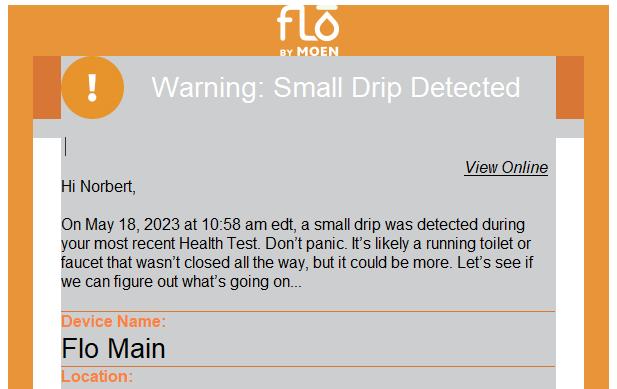
Leak detectors dramatically speed up response time for specific appliances, but what about slow leaks that waste water, may cause damage if undetected, or eventually turn into more seriously leaks? Flo does daily leak detection (normally during the night when there is no water usage) by shutting off the water for up to four minutest and checking the pressure on the 'house' side of the Flo valve. Any pressure drop implies water is leaking out of the system. Flo leak detection is quite sensitive - even a slow drip will trigger an alert.
Most often, the problem is a dripping faucet. Toilet issue (like leaking flappers or float valves) can be harder to detect - listen for the sound of float valve opening or add food colouring into the tank and see if it shows up in the bowl.
Having a diagram of the plumbing and all fixtures as well as shutoff valves that isolate fixtures and zones can speed detection, assuming that lack of use has not seized the shutoffs. I have been reworking plumbing as part of a bathroom renovation which meant shutting off the cold and hot supply lines. After fixing one unsuccessful solder joint (I am 'old school'), I restored water pressure and found no more leaks. However, Flo reported a small leak. Flo supports manually triggering leak detection allowing me to determine that the problem was on the cold supply but could not find the source of the leak. I had installed zone shutoffs years ago but did not have a diagram of fixtures. It turns out a toilet in a disused half-bathroom in the basement was the culprit - restoration of water pressure appears to have caused the float valve to leak. Of course, the shutoff for that toilet is completely seized.
Blog comments1
Good review of this! I…
Good review of this! I learned a lot.