MIT Technology Review (paywalled) recently published "Your AC habits aren’t unique. Here’s why that’s a problem" that describes how air conditioning can strain the electricity grid during the early summer evenings when people arrive home, fire up appliances, and also turn on the air conditioning. Electricity storage systems as well as demand management programs can can help match supply with demand and reduce the need to fire up 'peaker plants'. Another option is to shift electricity demand to off-peak periods. The MIT Technology Review article "Your future air conditioner might act like a battery" describes the IceBrick product where capsules of liquid frozen when energy is cheap can cool commercial buildings when electricity demand and prices are high. The Blue Frontier "desiccant cooling system" startup involves a different system with the same goal. Although the article points out that shifting demand to off-peak consumes more electricity due to conversion losses, it reduces the overall electricity cost.
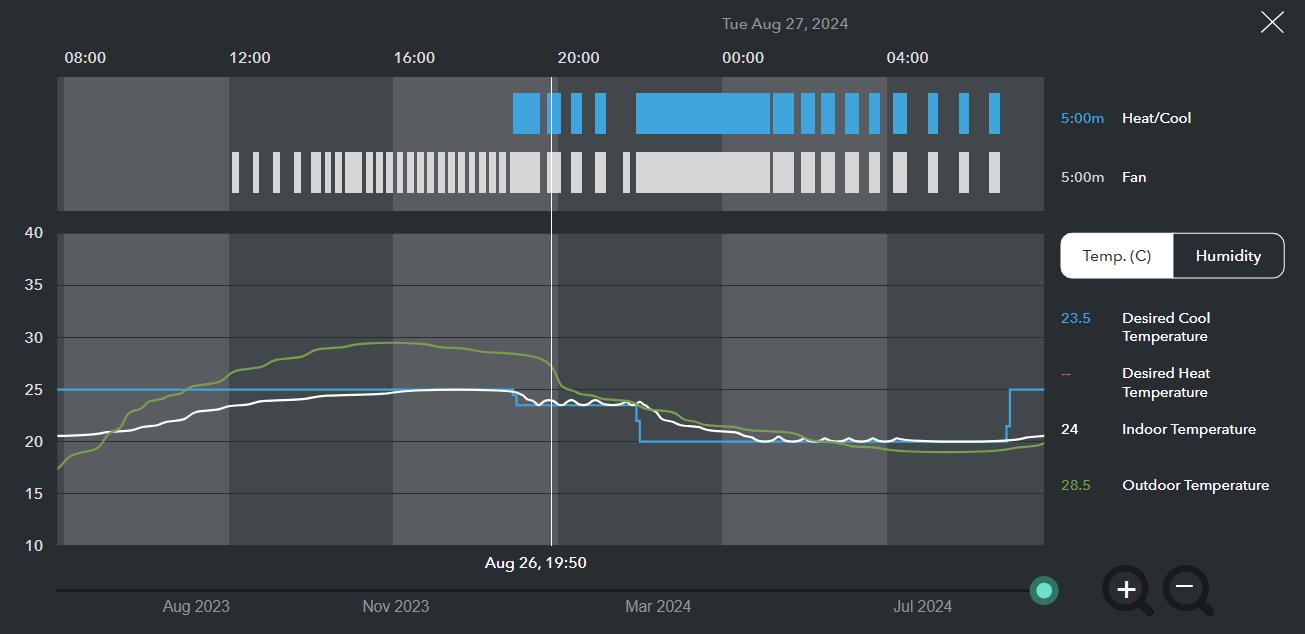
In 2011, I switched to Time of Use (TOU) billing from my electricity provider (Ontario's Hydro One) where off-peak electricity (weekdays/holidays and weekdays between 19:00 and 07:00) cost about 20% less than the flat rate. One of my energy usage adjustments was shifting air conditioning into off-peak by cooling the house to 21C (or a bit lower during long heat waves) at night, raising the air conditioner setpoint to 25C at 07:00, and dropping it slightly to 23.5C at 19:00. During the day, I cycle the furnace fan to draw cool air from the basement and keep the air from going stale. The screenshot picture above shows a day when outdoor temperature (green line) reached close to 30C, but the indoor temperature (white line) did not exceed 25C. Although the fan consumes electricity (runtimes shown by white bars at the top), it uses significantly less than the air conditioner (blue bars at the top). Your mileage may vary: I can adjust to the gradual increase in temperature during the day and the .Ecobee thermostat supports an Application Programming Interface that allows me to adjust the fan runtime from 5 to 30 minutes/hour based on the inside temperature.
Hydro One started the TOU off-peak hours early in the evening, probably to make the plan more attractive. Hydro One announced an Ultra Low Overnight (ULO) plan last year that charges 2.3rds of the off-shift rate for electricity usage between 23:00 and 07:00 each day. ULO also aligns pricing with peak demand - electricity rates are 57% higher than the previous on-peak rates on weekdays from 16:00 to 21:00. Next summer I will evaluate doing a short air conditioner cycle from 15:00 to 16:00 at mid-peak rates so that I can coast until 23:00.
Blog comments